After enduring two early season losses to Miami and Texas A&M, it became clear throughout the rest of the regular season that Notre Dame was6 one of the twelve best teams in college football. Before entering conference championship weekend, Notre Dame was ranked above the University of Miami (FL) by the College Football Playoff Selection Committee for what many believed was to be one available at-large berth to the tournament.
At the conclusion of Saturday’s conference championship games, the Selection Committee determined that Texas Tech’s ass-whooping of BYU (34-7) allowed Miami to leap past BYU in the rankings. Now, the committee was forced to look at Miami and Notre Dame for the final at-large berth: head-to-head. The Selection Committee was instructed to take another look at the game played on August 31st, where Miami beat ND, 27-24, at Hard Rock Stadium in Miami.
This game was the season opener for both schools. And now the Selection Committee was looking at a game played at the end of the summer as possibly the deciding factor to determine the final spot in the the CFP.
Based on other metrics both schools were near even. Miami’s two losses were to conference foes, SMU and Louisville. Notre Dame’s two losses were against Miami and CFP participant Texas A&M in the first two games of the season. ND ran the table after those two losses.
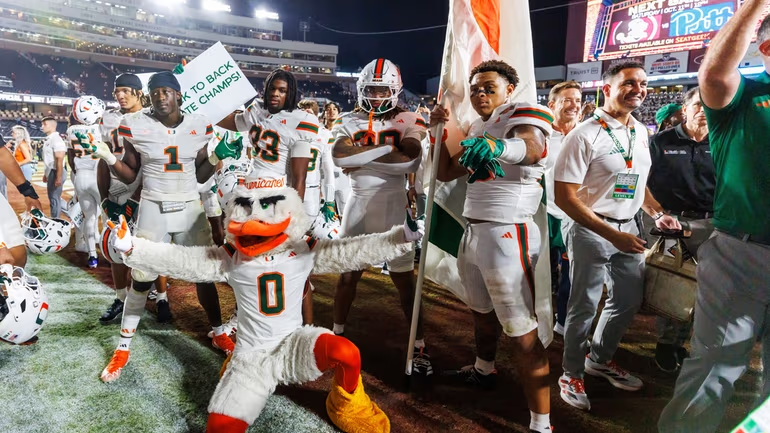
By noon on Sunday, the College Football Playoff Selection Committee had made the decison that Miami was deserving of the final at-large berth vaulting over Notre Dame. Neither ND or The U had played that weekend, but somehow BYU’s loss opened the door for the Canes to edge out the Fighting Irish. Miami would play Texas A&M in the first round of the CFP and Notre Dame would likely play BYU in the Pop Tarts Bowl.
If you have been around the block more than once, you realize that college football is a cesspool of backroom deals, good old boy handshakes and political machinations that would make Louis The XVI’s royal court look like a bunch of junior high amateurs in the use of deception and manipulation.
Notre Dame has chosen to be an an outlier in college football by retaining its status as an independent. (Notre Dame and UConn are the only true FBS independents.) Notre Dame has elected to use its brand and its large nationwide fan base to further the goals of Notre Dame. ND makes its own schedule (Though it does have an agreement with the ACC to schedule 5 ACC schools each year.), negotiate its own tv deal and retains every cent of that money, and when it plays in the postseason does not have to share a dollar with any fellow conference members.
Further, when Notre Dame enters into a scheduling agreement with another school it uses its brand as leverage to get the best possible deal. Notre Dame usually prefers a scheduling agreement where the Irish receive two home games and the opponent receives one. Or the Irish recieve a home game and the opponent will host the game at a neutral site. Exxamples of that are Notre Dame playing Boston College at Fenway Park and ND traveling to Met Life Stadium to take on Navy.
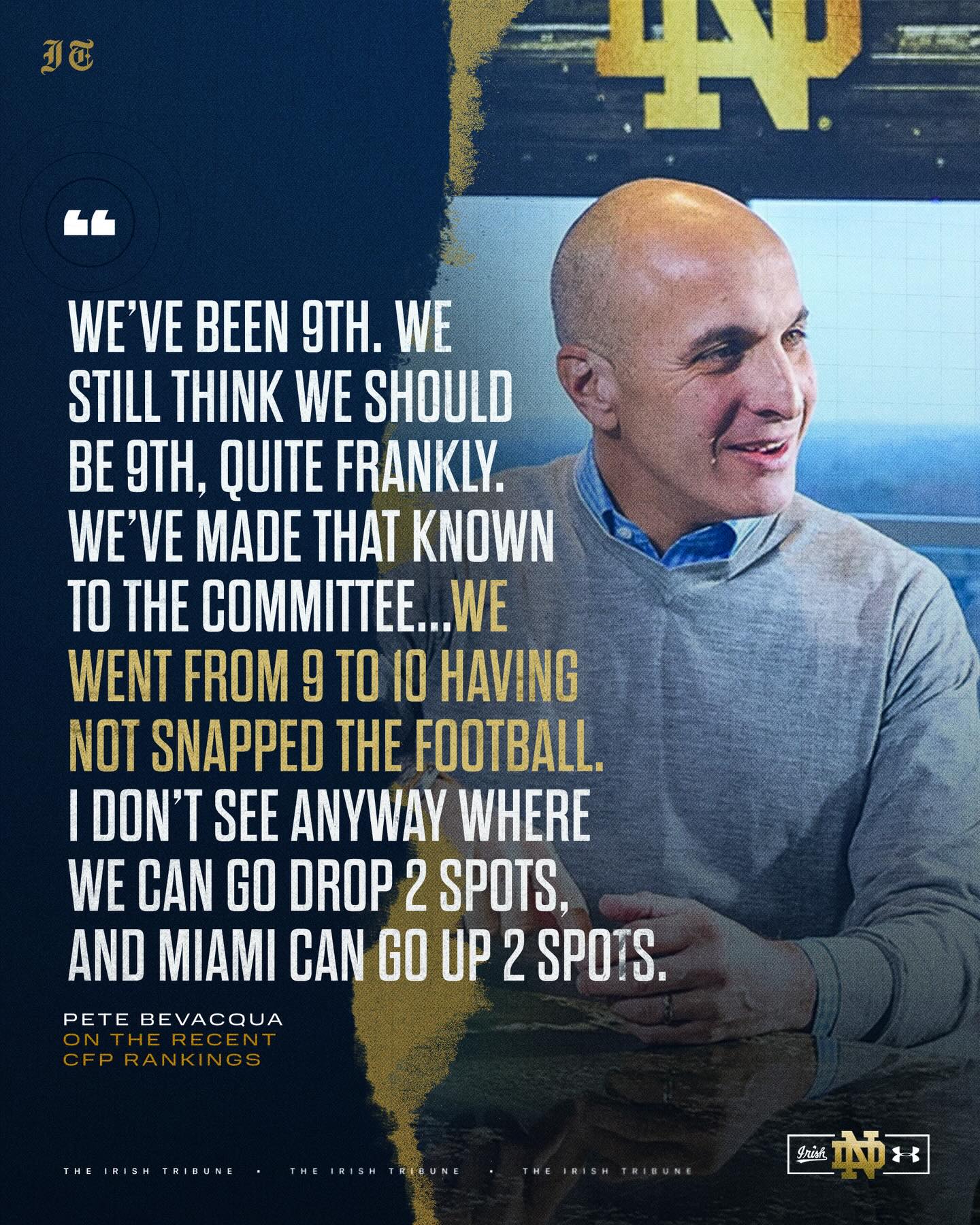
Notre Dame is the bully on the block and constantly seeks preferential treatment. For the 2026 season, Notre Dame Athletic Director Pete Bevacqua has already negotiated an agreement where the Fighting Irish are guaranteed a spot in the College Football Playoff if they finish ranked in the Top 12.
But when you are an outlier and you demand preferential treatment and strong-arm deals with other schools, enmity grows.
College football is made up of athletic conferences or alliances. Each alliance operates in the best interest of its member schools. Miami is a member of the ACC with 17 full-fledged member schools. Notre Dame, for its own convenience, joins the ACC for certain sports to raise that number to 18 schools.
If Notre Dame had been a member of the ACC, odds are it would have played in the ACC Championship game and secured an automatic berth.
But Notre Dame does not play well with others.
The Selection Committee is populated by folks who have served as athletic directors and coaches at major conferences. The University of Virginia’s Athletic Director Carla Williams is a member of the Selection Committee. UVA is a proud member of the ACC. (Who knows for how long?)
Does anyone believe that these stewards of college football are going to choose Notre Dame over Miami? If the ACC fails to earn a CFP berth, a Power 4 conference would see its value and marketabilty negatively impacted. The ACC is comprised of 17 schools in football. It has a large tv deal with ESPN. None of the stakeholders in college football want to see the value of the ACC diminished.
When you choose to go it alone and thumb your nose at the rest of college football, Notre Dame is not going to receive an invitation to the party. Join a conference like everyone else. (ND’s quest for superiority through exclusivity.) For a school who has not won a national championship since 1988, Notre Dame suffers from the delusion that it is still the largest program in the land. Georgia and Alabama might want to challenge the Fighting Irish on that conceit.
Miami pays protection money to the ACC (Miami will share CFP money with its ACC brethren.) and to the larger community of college football by being a member of the ACC. When Notre Dame is asked to pay protection money, it tells the friendly and well-dressed folks from the Big Ten or ACC to go fuck themselves. Well, this time ND fucked itself.
In a fit of pique and anger, Notre Dame has announced it will decline its bowl invitation proving once again that ND is all about ND. (The bowl system is in a perilous state.)
ND is an exclusive club of one. ND doesn’t need to be in a conference. Well, the Selection Committee just gave you the answer to that.
The next time we see Notre Dame football will be when the Irish visit Wisconsin on September 6th of 2026. The game will be played at Lambeau Field in Green Bay.



 toughdsheridan